
How to Check Criminal History in St. Tammany Parish
Start by deciding whether the goal is to find a prosecution, a recent booking, an originating police report, current custody, or a fingerprint-supported review of your own Louisiana record. The St. Tammany Clerk of Court Criminal Department is the primary local source for filed 22nd Judicial District Court cases and dispositions. The sheriff or a city police department keeps the event and booking records it created.
- Gather the full name, spelling variants, approximate date, location, and any case, incident, booking, or citation number.
- Search the clerk’s current court channel for a filed prosecution, or contact the arresting agency for the originating report.
- Use the jail or custody channel when the question is present confinement rather than case outcome.
- Compare the charge filed in court with the arrest or booking charge, then read the final disposition and sentence.
- For an official review of your own statewide record, follow Louisiana State Police Right to Review fingerprint instructions.
A name alone can match more than one person. Date of birth and record identifiers help distinguish results, but public online displays may still omit sealed matters, protected details, or older images. Certified copies come from the record custodian, not from a search-results screen.
One Parish, Several Records Custodians
Four records can grow from one arrest. The arresting agency writes the investigative and arrest report. A jail booking creates its own custody event, photograph, fingerprints, listed charges, and booking identifier. If prosecution is instituted, the district attorney’s charge and the clerk’s docket become a separate court file. Fingerprint and disposition reporting may later update the BCII repository.
| Question | Official starting point | Record produced |
|---|---|---|
| What did the responding agency document? | STPSO or the involved city police department | Incident or arrest report |
| Was someone booked locally? | St. Tammany Parish Sheriff | Booking and custody record |
| What charge was filed and how did it end? | St. Tammany Clerk of Court | Case docket, minutes, judgment, sentence |
| What appears on my Louisiana repository record? | Louisiana State Police BCII | Right to Review response |
These custodians also update on different schedules. A booking can appear before the district attorney has decided whether to file a charge, and a court disposition may take time to match back to the fingerprint-supported state cycle. When reviewing your own record, compare the source documents rather than assuming the newest screen has already synchronized every stage.
Official Louisiana Background Checks
The Louisiana Department of Public Safety and Corrections, Office of State Police, Bureau of Criminal Identification and Information maintains the statewide computerized criminal-history repository. Louisiana did not provide an unrestricted public name-search product in the official material reviewed. The Internet Background Check portal serves authorized agencies and statutory purposes.
Individuals may review their own Louisiana record through the fingerprint-based Right to Review process under La. R.S. 15:588. Louisiana State Police lists its background-check services and directs applicants to the appropriate forms and fingerprint instructions.
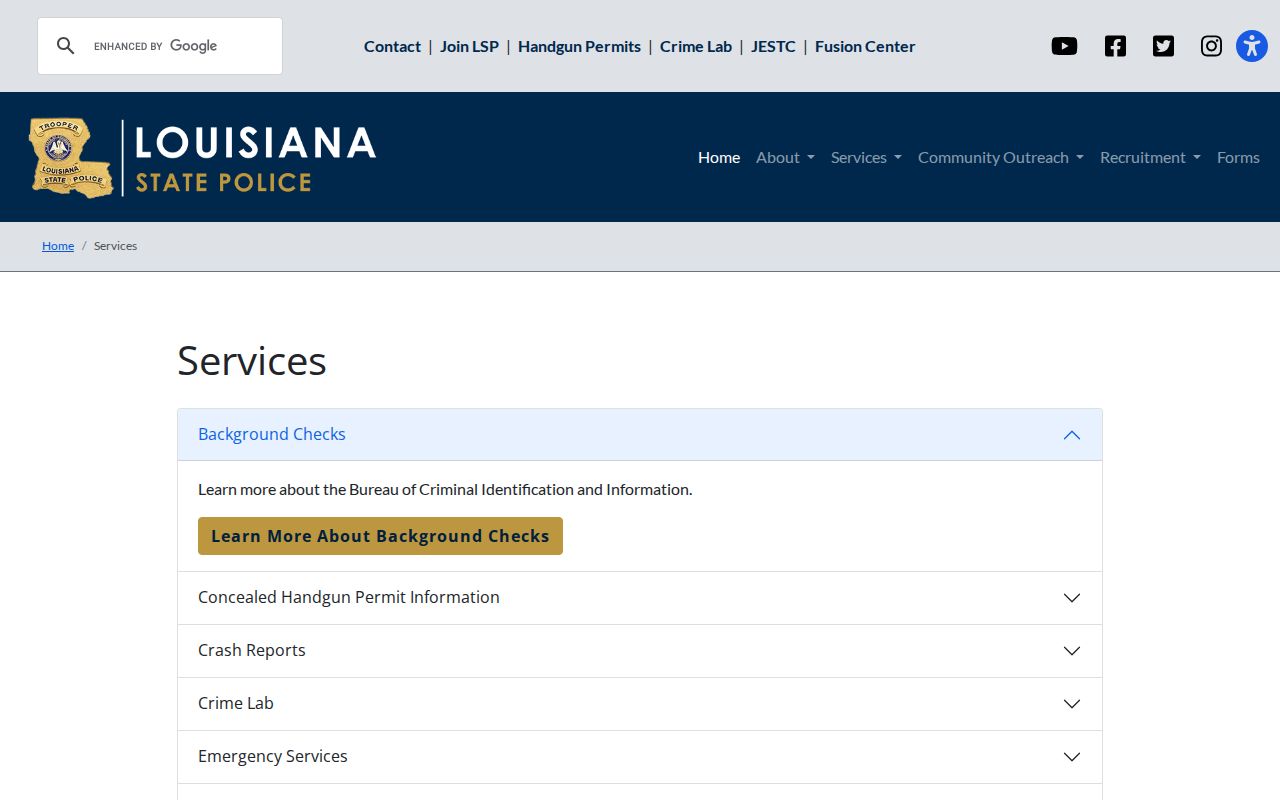
The official service directory is the safer starting point because LSP Criminal Background does not accept walk-ins and participating IdentoGO appointments depend on an agency-specific service code.
Three Eras of St. Tammany Court Records
St. Tammany criminal research changes with the record’s date. Current criminal cases route through re:SearchLA and the clerk’s present systems. Odyssey WebROA adds electronic data beginning in 1988 and images beginning April 25, 2019. The legacy subscription product covers criminal records from 1988 through April 25, 2019. Criminal files from 1810 through 1976 use the separate archival request process.
The clerk’s Criminal Department page identifies its systems and contacts for public criminal records.
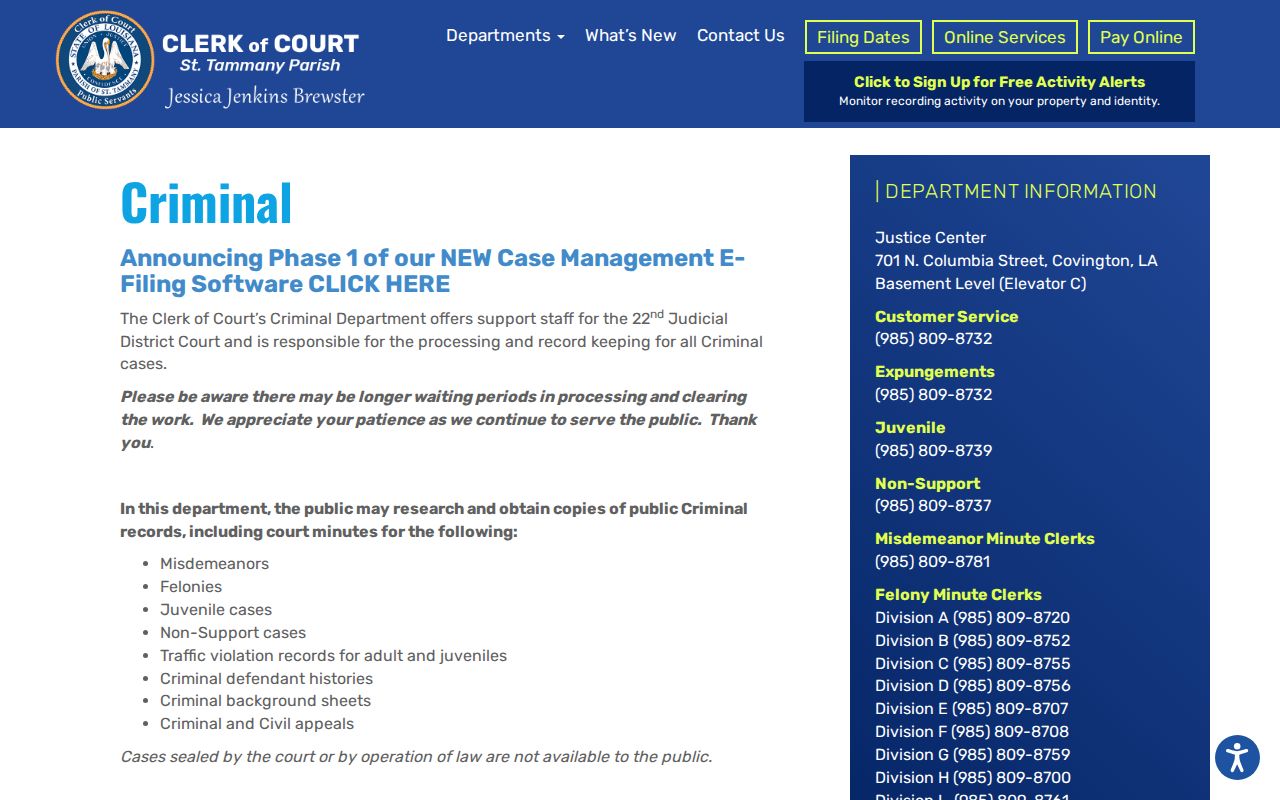
The displayed department links help separate online research from copy requests, expungements, juvenile access, and direct minute-clerk questions.
| Record period | Channel | Practical note |
|---|---|---|
| Current cases | re:SearchLA / clerk links | Current portal and fee status may change during the clerk’s system transition. |
| 1988 to April 25, 2019 | Legacy criminal records | Published subscriptions are $20 for 24 hours or $30 monthly. |
| 1988 forward, images after April 25, 2019 | Odyssey WebROA | Older entries may lack online document images. |
| 1810 to 1976 | Clerk Archives request | Specify desired documents to control per-page cost. |
Types of Criminal Records
Record labels are not interchangeable. An arrest is an allegation and custody event, while a conviction is a court outcome. A warrant is a judicial command that may not appear in a civil-process inquiry. Probation and parole supervision are distinct from jail or prison custody, and registry information follows its own statutes.
- Police report
- The originating agency’s narrative, observations, and collected event information.
- Booking record
- The jail’s intake entry, identifiers, listed arresting agency, charges, and custody status.
- Criminal case file
- The clerk’s charging document, docket entries, minutes, pleadings, disposition, and sentence.
- Repository record
- Fingerprint-supported arrest cycles and reported dispositions maintained by BCII.
- Custody locator
- A current-status tool, not a complete criminal-history report.
Dedicated parish explanations are available for criminal court cases, arrest history, and the sex offender registry.
Warrants require particular care because the sheriff’s public civil inquiry does not answer a criminal-warrant question. A bench warrant can arise in a court docket, while another warrant may belong to a city court. Contact the court or issuing agency through its official channel, especially when trying to resolve your own warrant. Do not infer warrant status from an unrelated civil search.
What the Sheriff Holds and What It Does Not
STPSO holds sheriff-created incident, arrest, booking, and jail records. It does not automatically hold a Slidell, Mandeville, or Covington police report merely because the event occurred within the parish. A useful request identifies the date, place, involved agency, report number if known, and the precise record sought, such as an initial report, booking sheet, dispatch entry, 911 audio, or video.
The St. Tammany Parish Sheriff’s Office site provides its official service navigation.

The sheriff’s public Civil Process and Foreclosure System is not a criminal-warrant search. For current booking, warrant, or public-record routing, use the specific channel supplied by STPSO rather than interpreting a civil case result as criminal-history evidence.
What a St. Tammany Parish Criminal Record Shows
The available fields depend on the record. Court files emphasize filed charges and judicial events. Booking records emphasize intake and custody. Repository records join fingerprint-supported cycles to dispositions reported back by courts.
| Name & Identifiers | Legal name, aliases, date of birth, and record-specific identifiers when public. |
|---|---|
| Arrest / Booking Data | Arresting agency, date, booking number, listed charges, and custody status. |
| Charges & Statutes | The allegations at arrest and, separately, the charge instituted by information or indictment. |
| Disposition | Dismissal, acquittal, plea, conviction, or another recorded case outcome. |
| Sentence | Custody, probation, fines, conditions, or other judgment details in the court record. |
| Supervision Status | State probation, parole, or custody information through the responsible agency. |
A dismissal does not automatically make the arrest invisible. The booking record, court disposition, and BCII cycle can remain in different systems unless legal relief applies and reporting is complete. For a suspected mismatch on your own history, obtain the court disposition first, compare it with the Right to Review response, and follow the source-correction instructions of the agency responsible for the inaccurate entry.
Researching at Elevator C
The Clerk’s Criminal Department is in the basement of the St. Tammany Parish Justice Center, reached by Elevator C, at 701 North Columbia Street, Covington. It is open Monday through Friday, 8:30 a.m. to 4:30 p.m. General Criminal Customer Service and Expungements uses 985-809-8732. The clerk also publishes direct minute-clerk numbers for felony Divisions A through J.
The Slidell Annex at 520 Old Spanish Trail, fifth floor, offers an east-parish counter from 8:30 a.m. to 4:30 p.m., but closes from 1:00 to 2:00 daily. Call 985-643-6969 before assuming that a particular archive or certification service is available there. Security rules for the Justice Center were not located in the reviewed official material, so visitors should confirm rather than infer restrictions.
The clerk’s service lines also divide work by record type. Juvenile routing uses 985-809-8739, Non-Support uses 985-809-8737, and misdemeanor minute clerks use 985-809-8781. Calling the correct unit with a docket number can avoid transferring a request between felony, misdemeanor, juvenile, archive, and expungement functions. The Elections Office on North Jefferson Street is not the criminal-record counter.
For an older file, contact Clerk Archives at 985-809-8746 or Archives@sttammanyclerk.org. The archive mailing address is P.O. Box 1090, Covington, LA 70434. Records from 1810 through 1976 use the archival request, while records from 1977 forward use the current criminal copy process. Asking for a particular pleading or minute entry can be more economical than ordering an entire historical file.
Public Access Laws
Louisiana Public Records Law generally supports inspection of public records, but criminal files contain important exceptions. Pending-investigation material, protected victim identities, juvenile records, sealed matters, and other confidential information may be withheld or redacted. An initial report, booking record, citation, and bill of information can be treated differently from investigative supplements.
Key Louisiana laws:
La. R.S. 44:36 sets public-record retention rules.
La. R.S. 15:587 governs criminal-history dissemination and authorized checks.
C.Cr.P. art. 972 defines Louisiana expungement terms.
C.Cr.P. art. 973 explains the effect of expungement and authorized confidential access.
C.Cr.P. art. 986 requires statewide expungement forms.
Inspection can be free while reproductions carry reasonable charges. For a large paper, audio, or video request, ask the custodian for a written estimate before authorizing production.
Specificity improves a request and helps the custodian separate public material from protected portions. Supply the event date, location, originating agency, known identifier, and exact document requested. A request for an initial report or booking sheet is more workable than a demand for every record connected to a name, particularly when an investigation or anticipated prosecution remains pending.
Ten Felony Divisions in the 22nd JDC
The 22nd Judicial District Court serves St. Tammany and Washington Parishes. St. Tammany felony work is divided among Divisions A through J, while misdemeanor, juvenile, non-support, and appeals work have separate clerk routing. The division is therefore more useful than a general switchboard once it appears on a docket.
The official 22nd JDC site identifies the court’s divisions and programs.

The court information places a local case in its proper judicial setting, while the clerk remains the custodian for public case filings, minutes, and copies.
Sealed, Expunged & Restricted
Louisiana expungement removes qualifying arrest or conviction records from public access but does not destroy them. Authorized agencies can retain confidential access where statutes allow it. Interim expungement and expungement by redaction are distinct statutory forms, and the clerk states that sealed matters are unavailable to public researchers.
The published St. Tammany fee stack totals $550 when every statutory component applies: $250 to the clerk, $50 to the district attorney, $50 to the sheriff, and $200 to Louisiana State Police. Exceptions may apply, including the no-cost expedited route in C.Cr.P. art. 999 for qualifying arrests at age seventeen. Eligibility changed in 2024, so current statutes and mandatory forms should be checked before filing.
Expungement is not the same as correcting a mistaken disposition or resolving an open case. A person who finds an unresolved arrest cycle should first determine whether the court outcome was reported accurately. Relief eligibility depends on the actual charge, disposition, waiting period, exclusions, and current law, not merely on whether a public portal returns a result.
From Arrest Charge to Filed Charge
A booking charge is not necessarily the charge that reaches court. The 22nd Judicial District Attorney decides whether and what to institute by bill of information, while a grand jury may return an indictment. Once filed, the clerk’s docket records arraignment, pleadings, minute entries, disposition, and sentence.
The 22nd Judicial District Attorney’s official site describes local programs and contacts.

This prosecutorial stage explains why an arrest record and a later court file can list different charges without either record being a duplicate.
St. Tammany Search and Copy Costs
The clerk’s published schedule distinguishes access subscriptions, searches, copies, and certification. Ask whether an online image is available before ordering paper, and specify the bill of information, minutes, or judgment if the entire archive file is unnecessary.
| Service | Published amount | Note |
|---|---|---|
| Legacy portal access | $20 / 24 hours | Criminal coverage through April 25, 2019 |
| Legacy monthly subscription | $30 / month | Published legacy price |
| Clerk certified name search | $20 | Use when a certified clerk search is required |
| Archival copies | $1 / page | Certification and postage may add cost |
| STPSO copies | Fee not located in official sources | Request the current schedule and an estimate |
The clerk’s modernization work makes live verification important. A 2025 system transition and historical-record conversion project can change navigation, subscription terms, and available images even when the underlying courthouse record remains available. Treat the clerk’s current page and written estimate as authoritative for an order placed today.
Criminal Records by City in St. Tammany Parish
Slidell, Mandeville, and Covington police departments keep the reports they create, while city courts keep their municipal or statutory dockets. Parish booking and district prosecution can then add separate STPSO and clerk records.
Slidell Criminal History
Start with Slidell PD for its report, City Court for city matters, and the clerk’s Slidell Annex for parish records.
Mandeville Criminal History
Mandeville Police, the municipal or Mayor’s Court channel, and parish custodians hold different parts of an event.
Covington Criminal History
Covington has separate police, Mayor’s Court, parish clerk, Justice Center, and jail access points.