
Criminal Cases in the St. Tammany Parish Courts
The 22nd Judicial District Court serves St. Tammany and Washington Parishes. Its St. Tammany criminal docket includes felonies and parish-level misdemeanors, while the St. Tammany Clerk of Court maintains the public case file. The Criminal Department also processes juvenile matters, non-support matters, adult and juvenile traffic, defendant histories, background sheets, and criminal or civil appeals, though juvenile and sealed access remains controlled.
Municipal and city courts are separate custodians. Slidell City Court and the municipal or Mayor’s Court channels in Mandeville and Covington may hold ordinance, traffic, or other limited-jurisdiction matters that never become a 22nd JDC case. A failed parish search therefore does not prove that a city citation or city-court warrant does not exist.
Calling the Correct Division A–J Clerk
The clerk publishes direct minute-clerk numbers for the ten felony divisions. Division A uses 985-809-8720; B, 985-809-8752; C, 985-809-8755; D, 985-809-8756; E, 985-809-8707; F, 985-809-8708; G, 985-809-8759; H, 985-809-8700; I, 985-809-8761; and J, 985-809-8700. The general criminal and expungement line is 985-809-8732, and misdemeanor minute clerks use 985-809-8781.
Call the assigned division after locating it on the docket. A case number, defendant name, and approximate filing date make routing more precise. The Criminal Department counter is in the basement of the St. Tammany Parish Justice Center, reached by Elevator C, at 701 North Columbia Street in Covington. Published hours are Monday through Friday, 8:30 a.m. to 4:30 p.m.
How to Search Case Records
The Clerk’s Criminal Department links current criminal research to re:SearchLA and identifies the local record channels. Current systems and fees are changing during the clerk’s case-management transition, so follow the live official link rather than a saved third-party portal address.
- Open the clerk’s official Criminal Department page and choose the current criminal research system.
- Select the criminal case category and search with a full party name or exact case number.
- Narrow the results by parish, filing year, case type, or other displayed filters, then compare identifiers.
- Open the docket and read the chronological entries, filed charge, minutes, disposition, and sentence.
- Request an uncertified or certified copy from the clerk when the online display is incomplete or formal proof is needed.
| Search field | Type | Required | Use |
|---|---|---|---|
| Last name | Text | Search-dependent | Use the full spelling and try known variants. |
| First name | Text | Search-dependent | Narrows common surnames. |
| Case number | Text | No, if using a name | The most precise route when known. |
| Parish / court | Select | Often | Choose St. Tammany and the criminal court category. |
| Filing year / case type | Filter | No | Separates similar names and date eras. |
re:SearchLA, Odyssey, and Legacy Differ
re:SearchLA is the statewide Louisiana Clerks Remote Access Authority portal linked for current research. Odyssey WebROA provides electronic data beginning in 1988 and document images beginning April 25, 2019. The St. Tammany legacy criminal product covers 1988 through April 25, 2019. These date ranges explain why an entry can exist without an online image or appear in one system but not another.
The official legacy membership page publishes its historical criminal coverage and pricing.
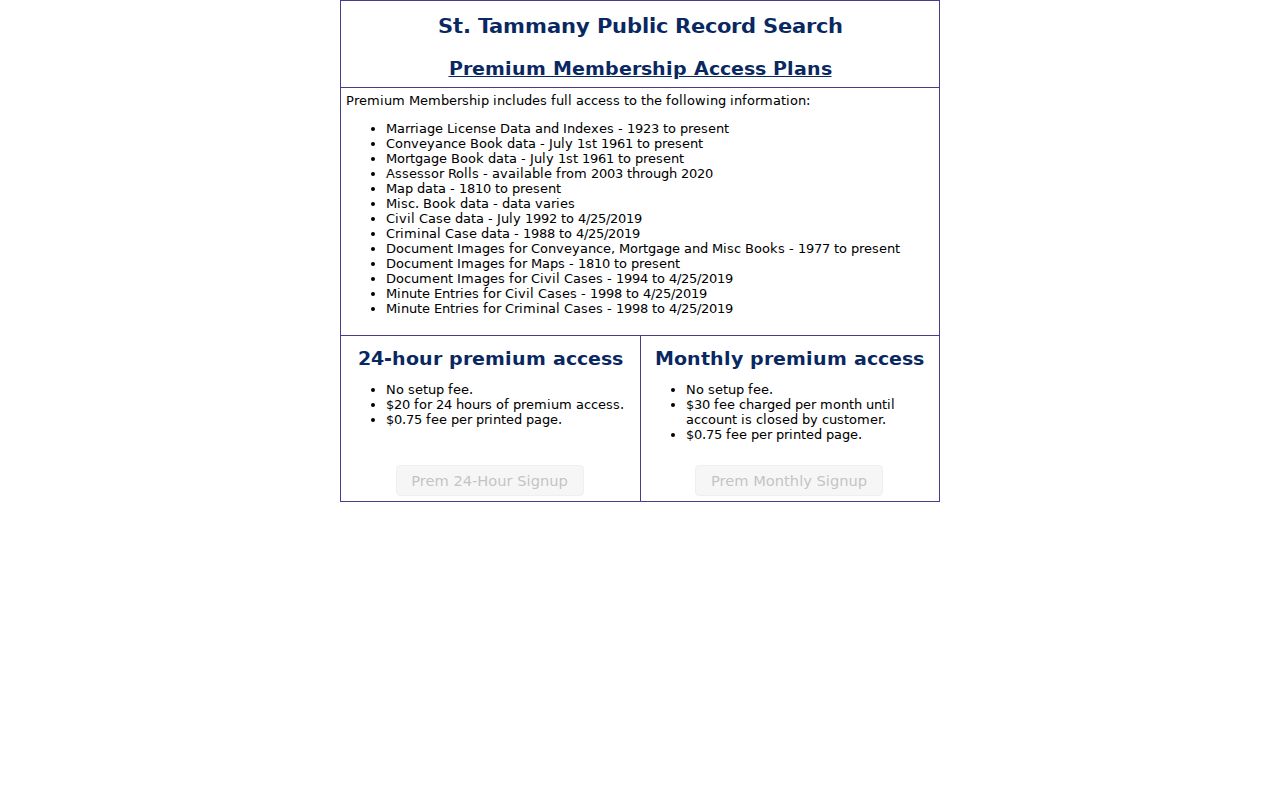
The legacy display documents $20 access for 24 hours and a $30 monthly option, but it should not be mistaken for complete current coverage after its April 25, 2019 endpoint.
The clerk’s recent case-management and e-filing work means portal navigation and pricing should be treated as actively changing. Begin at the official clerk page each time. A bookmarked legacy login can remain functional for its published historical range while still being the wrong source for a newly filed prosecution.
What the Case File Shows
A criminal court file records what prosecutors filed and what the court did. It does not simply repeat the booking charge. The most useful document depends on the question: a bill of information or indictment identifies the instituted charge, minutes record courtroom events, and a judgment or sentencing entry supplies the outcome.
| Case Number & Court | The docket identifier, assigned court, division, and filing context. |
|---|---|
| Charging Document | The bill of information or indictment stating the charge brought in court. |
| Docket Entries | A chronological index of filings, motions, notices, and court activity. |
| Hearing Dates | Arraignment, motion, pretrial, trial, and sentencing settings recorded by the clerk. |
| Disposition & Judgment | The dismissal, acquittal, plea, conviction, or other final result. |
| Sentence & Conditions | Custody, probation, fines, conditions, and other terms reflected in the judgment. |
Read status labels with the dated minute entries. A charge shown at filing may later be amended, dismissed, or resolved through a plea to a different count. The last docket line is not always a complete substitute for the signed judgment.
Ordering an 1810–1976 Criminal File
Criminal records from 1810 through 1976 use the clerk’s archival request rather than the modern portals. Archives can be contacted at P.O. Box 1090, Covington, LA 70434, 985-809-8746, or Archives@sttammanyclerk.org. The published archival copy price is $1 per page, with certification and postage potentially added.
Specify the bill of indictment, minutes, judgment, or transcript if only that material is needed. The archive form’s default treatment of an entire file can increase the page count substantially. For records from 1977 forward, use the current criminal-record copy form and Criminal Department routing rather than the archival form.
Certification and ordinary copying answer different needs. Ask for certification only when an authenticated clerk copy is necessary, and obtain a cost estimate when the file may be lengthy. The Slidell Annex is a convenient east-parish counter, but callers should use 985-643-6969 to confirm that the requested archive or certification service is available there before traveling.
Stages of a Criminal Case
An arrest begins a law-enforcement record, but a district court case takes shape only after a charge is instituted. The district attorney may file a bill of information, or a grand jury may return an indictment. The clerk then records the court events that lead to a plea, trial, disposition, and sentence.
Case flow: Charges Filed › Arraignment › Pretrial › Plea or Trial › Disposition › Sentencing
A first appearance, bond event, or booking may occur before the complete district docket is visible. Conversely, a court file can continue after local custody ends. Search by the filed case number when possible and treat the booking number as an agency identifier, not a substitute for the docket number.
Minute entries provide the most useful chronology when a case changes course. Read them alongside the charging document and final judgment so that a scheduled hearing, amended charge, or interim ruling is not mistaken for the disposition.
Why Booking and Filed Charges Differ
The arresting officer and jail record charges associated with the arrest and intake. The district attorney later evaluates the evidence and decides which charge, if any, to institute. A grand jury can also return an indictment. That process may narrow, change, add, or decline allegations that appeared at booking.
For the event narrative, request the report from the arresting agency. For the fact and timing of local custody, use the booking record. For the legally filed charge and outcome, rely on the clerk’s case file. The St. Tammany arrest history page explains the arrest and booking side without treating an arrest as proof of guilt.
When Online Criminal Images Are Missing
An index entry without a document image can reflect the portal’s coverage date rather than a missing case. Odyssey’s electronic data begins in 1988, but its stated image coverage begins April 25, 2019. Older legacy coverage ends on that same date, and pre-1977 records take the archive route.
First confirm the filing year and system. Then call the division minute clerk or Criminal Customer Service with the case number. A copy request should identify the exact document and whether certification is required. The clerk’s published certified name search costs $20; copies, certification, and postage follow the applicable schedule.
Louisiana State Police separately publishes repository review and fingerprint forms.
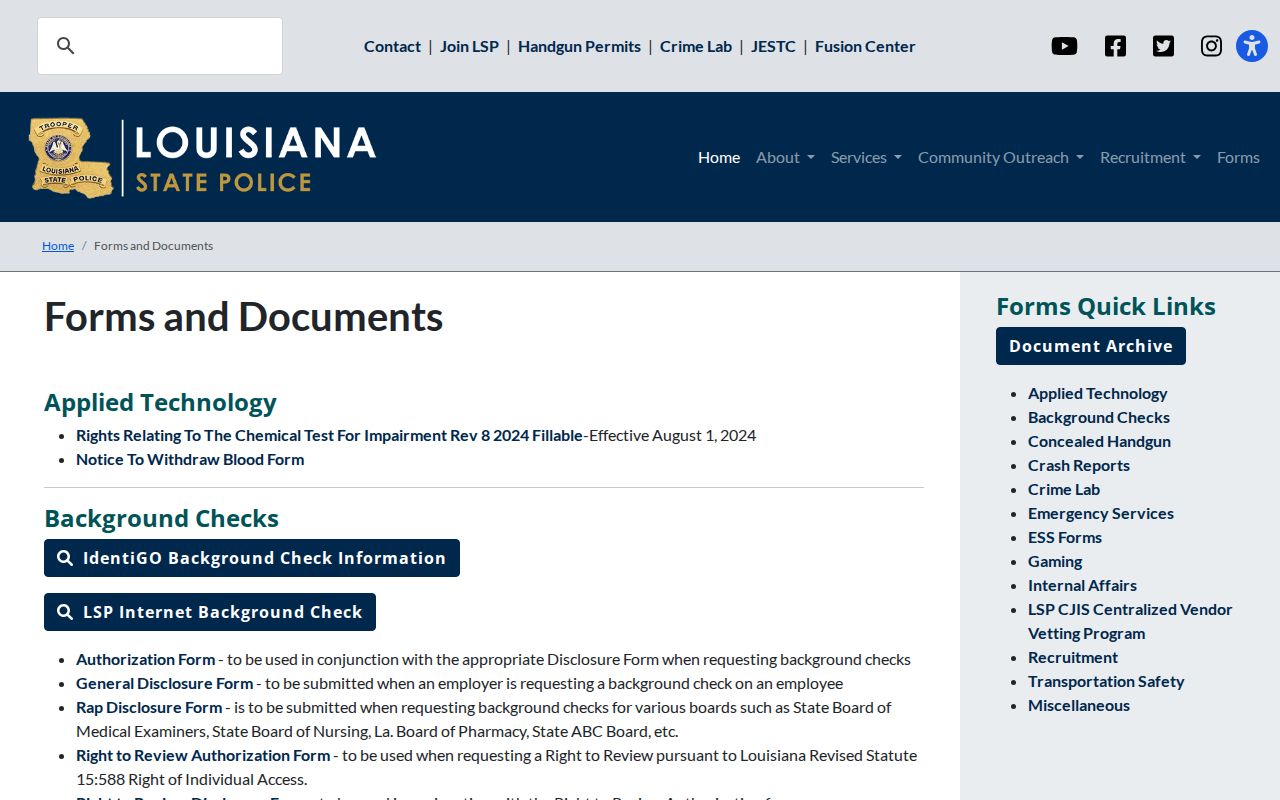
Those state forms serve repository self-review, not replacement copies of a St. Tammany court pleading. Court documents remain with the clerk.
Access & Restrictions
Public court access is subject to sealing, expungement, juvenile confidentiality, protected victim information, and other statutory limits. The clerk expressly states that sealed cases are unavailable for public research. Louisiana expungement removes qualifying records from public access without destroying them, and authorized confidential access can continue under C.Cr.P. art. 973.
Online views may redact information that appears differently in the controlled courthouse file. A no-result search can also stem from spelling, a date-range mismatch, a city-court case, delayed indexing, or an archive-only record. Ask the clerk to confirm the appropriate channel without assuming that an absent public result means no record exists.
Access note: Louisiana Public Records Law does not make every item in a criminal file public. Pending-investigation material, juvenile records, sealed filings, protected identities, and legally confidential information can be withheld or redacted. The record custodian determines the response under the applicable law.
If the goal is to correct your own statewide criminal history, a court search is only one part of the process. Obtain the clerk’s disposition, then compare it with the fingerprint-based Louisiana State Police Right to Review response. A court clerk can certify its own judgment, while the originating agency or BCII addresses its respective source data and repository entry.